

Do you need this?
a skiing starter pack

More of a “What should I buy?” than a “Should I buy this?” from a good friend of mine who was recently invited on a ski trip to the French Alps and asked me what she needed for her first alpine adventure.
While she’s never skied before, she’s never shied away from a challenge, and she’s certainly never turned down an opportunity to curate a good outfit. For these reasons, I knew instantly that she would absolutely excel at skiing, if not the actual sport, then at least the joie de vivre that it certainly requires. Furthermore, I felt honored that she asked me — a Colorado native and outdoor-gear enthusiast — to help her.
The task of explaining how to build a ski outfit basically involved going through my own ski bag and explaining all the bits and pieces, things I love most, and the logic behind each of them. Like a good skincare routine, there are many layers to a ski outfit. Also like a skincare routine, the layers must be applied in the correct order in order to function properly.
Below is the advice I gave her, originally in the form of several very long voice memos, now distilled into a (somewhat) succinctly written form for you.
1. Baselayer
The base layer is one layer — closest to your body — and comprises three items: socks, leggings, and a top. It is very important that none of these pieces are made from cotton. You will sweat, the cotton will stay wet, and you will be very cold and very sad.
I have friends who have used Uniqlo HEATTECH as their base layers for years, but if you can spring for it, a Merino wool option is going to be better and last longer than something synthetic (though most brands use a blend of Merino wool and/or synthetic material). If you’re going on a one-time trip and looking to save a bit of money, you can get away with a long-sleeved exercise top and moisture-wicking leggings.
Do not skimp on ski socks, however! Cold toes ruin lives, and you need socks that are high enough to compress your calves and stay put in your boots. It’s a bit backward, but you don’t want the thickest socks you can find; a thinner wool sock will allow more circulation to your feet and fit comfortably inside your ski boots.
My personal base layer picks are below, but if you check out the gals over at TOGS, they are real experts and have many more recommendations.
2. Mid layer(s)
1-2 Additional layers. Once you have your base layer top, you need something (or things) slightly thicker before you don your outer ski jacket. These layers might change depending on how your internal temperature runs and how cold it is where you’re skiing. I tend to run cold, but I generally wear one thinner fleece layer and one lightly insulated full zip jacket.
Note: For the purpose of this guide, the mid layers only refer to the top — you usually don’t wear more than one pair of bottoms underneath your ski pants unless it’s very cold. If that happens, you can cop a pair of insulated pants like these, but they are probably unnecessary (I’ve never worn them).
3. Insulated (Down)
This is the last layer before your shell (and can technically be considered part of your mid layers, though I almost always wear one down-filled layer, regardless of which other mid layers I wear. Again, be creative as you build this outfit. Express yourself. But when in doubt, wear one layer of down.
The insulated layer is another place where you should look for sustainable options. Look for items marked with “Responsible Down Standard” to ensure that they adhere to the RDS: a voluntary program that certifies products containing down and feathers are from animals treated humanely.
**Again, in a pinch, Uniqlo Down can work here! You don’t need to spend hundreds on each item of clothing. Personally, I am a fan of buying high-quality items you can buy once and wear for life (most of my ski gear is 10+ years old!), but if you are on a tight budget, you don’t need to buy all high-end gear. Will it last as long? Maybe not. But if you’re only skiing for the weekend, it will likely do the job of keeping you warm.**
4. Bottoms
You can opt for traditional ski pants or “bibs”, which are sort of like a waterproof set of overalls. I am a huge fan of bibs. I love them. But feeling like a giant toddler is not for everyone, and I’ve also spent many happy years in traditional ski pants. No matter your choice, there are many styles and ways to express yourself here. I have never been one to wear the soft, stretchy, fancy ski pants, but they do look chic if you’re going for a more elegant, Slim-Aarons-inspired ensemble. In general, no matter the style, look for windproof and/or waterproof materials.
5. Outer Layer
This is your final layer, your ski jacket. It should be water-repellent. Gore-Tex is nice but not always necessary. Some ski jackets have insulation, in which case, you may need fewer mid-layers (see how this becomes a bit of a choose-your-own-adventure?). For reference, I own three ski jackets, all of which are “shells,” meaning they have no insulation. Instead, I build my own insulation using mid-layers depending on the weather and what type of skiing I’m doing (downhill vs. backcountry). If you run extra cold or you want to buy fewer layers, you can buy an insulated jacket. Just make sure you try it on with your other layers to ensure that everything fits together.
6. Accessories
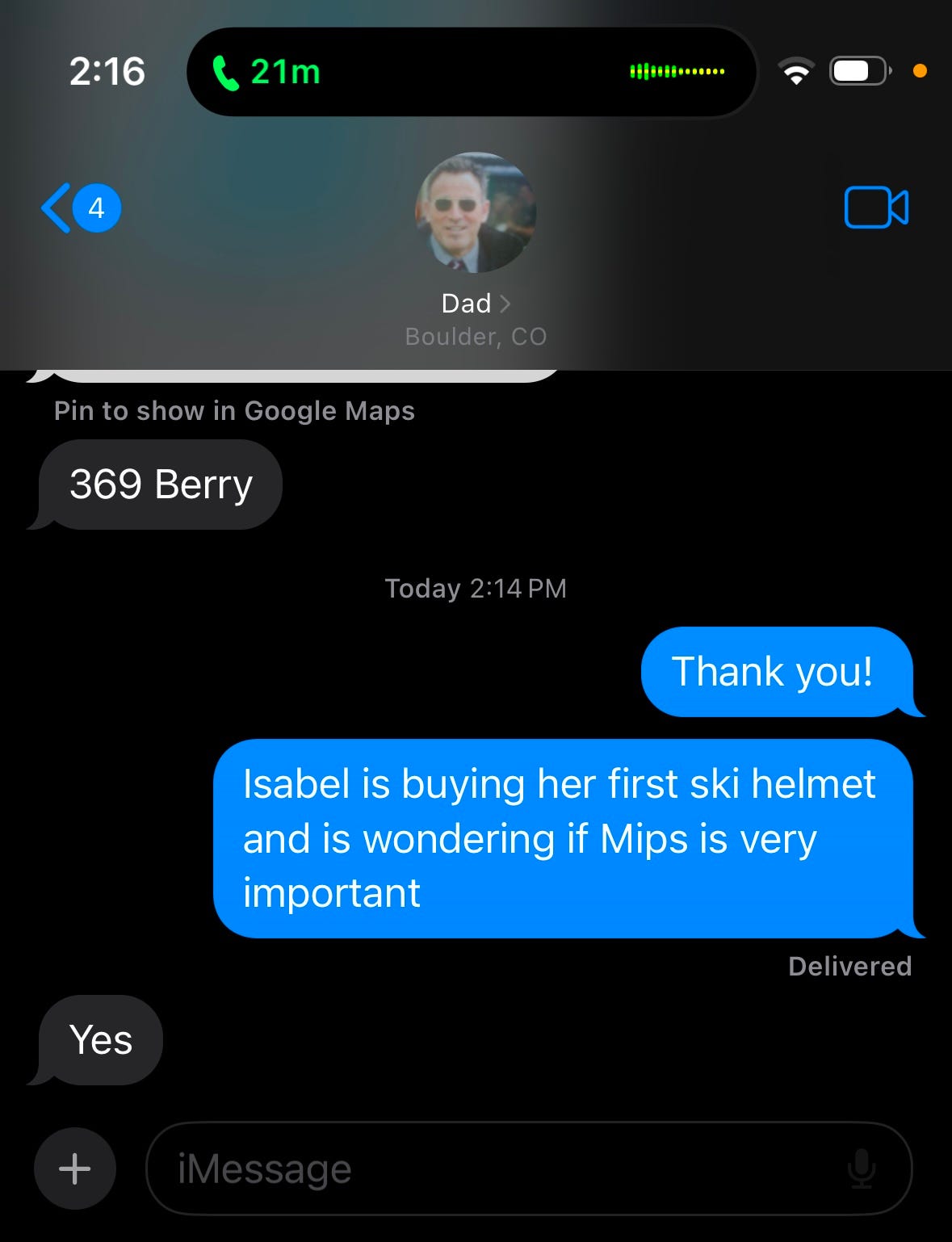
Helmet - I don’t care how chic it looks to wear a beanie while skiing; you must wear a helmet. When purchasing one, make sure you try it on so you can see which brand and size fits your head the best. Best to splurge on a helmet that’s made with Mips, a helmet technology that protects your brain in the event of a crash. Pricier, but important. (I even double-checked with my dad.)
Goggles - I have only ever worn one lens in my goggles. Some people change out lenses depending on light — sunny vs. low light — because it can be harder to see in certain conditions. To get around this issue, I recently bought a pair of goggles with lenses that change depending on the light. A quick Google search tells me that these are called “photochromic.” They are fancy! Many brands make them! That said, I also skied for year in an old pair of Smiths that were fogged and peeling, and I was just fine. You will be, too.
Mittens - If you have normal circulation, you might be able to get away with regular ski gloves (with five separate fingers or even a three-finger model). But in my experience, fingers have a better chance of survival if they’re naked and huddled together for warmth, and so you need a mitten. But! Many mittens sneakily have finger separators inside their lining (WHY?!), so this is something you usually need to try on in person.
Gaiter - This is the smallest, most important piece of ski gear you can own. It will protect your neck and face from windburn, sunburn and general discomfort. You should have a few of these in your rotation, however, because no matter how hot and cool you are, you will snot all over your gaiter and end up with a crusty, wet mess around your neck by the end of the day.
7. Skis, Poles and Boots
Rent these if you’re a newer skier. Any ski shop pro can direct you to the correct boot fit, ski size, and type, depending on your ability. These are expensive items to purchase, and I’d advise renting a few setups before settling on which kinds you’d like to buy.
As a heads up: rental boots (and sometimes skis) are usually crappy. For a higher cost, you can “demo” nicer/newer boots and skis instead. This might be worth it depending on how long you’ll be skiing and what options the rental shop has. If you are set on purchasing your own setup, below are the skis, poles, and boots I love.
Versions I love of the above
Here are my personal tried-and-true versions of the ski starter pack.
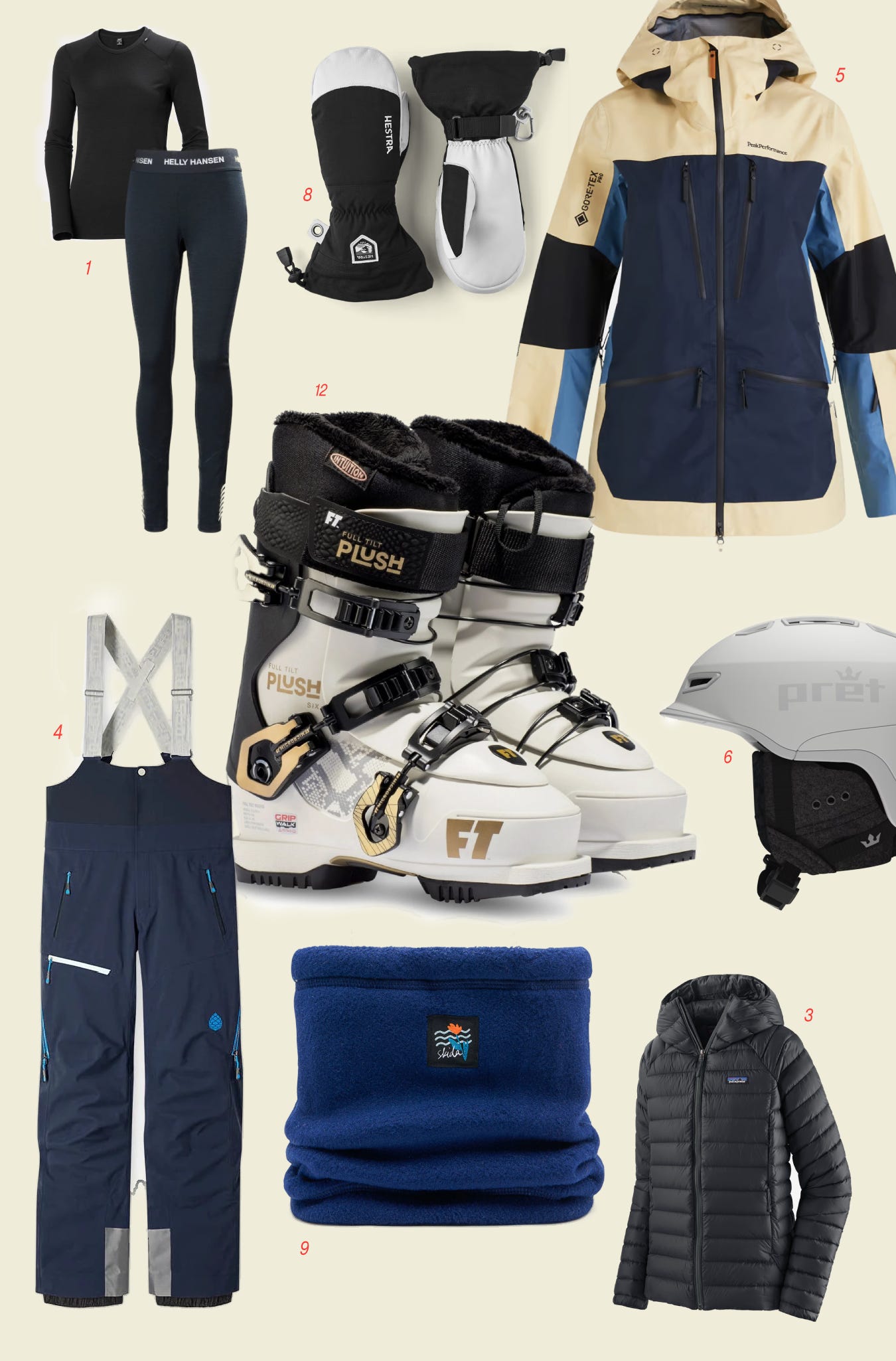
Baselayer: My most-worn baselayers are old Patagonia Capilene or Helly Hansen Merino. For socks I usually wear Smartwool but I have heard very good things about the Stio socks as well.
Mid-layers: I layer one of both of these: Fleece Patagognia 3/4 Zip (mine is much older but this one is similar) & Patagonia Nano Puff.
Insulated: I only wear the Patagonia Down Sweater Hoody (although this one from Peak Performance is on my wish list for 2025).
Bottoms: I alternate between two bibs — the Stio Environ (Also, I don’t own but I LOVE these). and a Gore-Tex pair from Peak Performance (also discontinued).
Outer layer: I alternate between a Stio Environ shell and Peak Performance Vertical Pro Gre-Tex 3L jacket (discontinued but pictured above).
Helmet: I recently started wearing a Pret Helmet. So far it’s made me feel very safe. I used to have a Smith helmet, also quite nice.
Googles: My favorites from Zeal (the photochromic lens is discontinued on the Hangfire model but can be found on this model).
Mittens: The OG and best - Hestra.
Gaiter: Skida makes the best in several weights - I mostly alternate between the Snow Tour and Low Pile Fleece Tube.
Skis: I have skied Line Pandoras for about 15 years. They are perfect for every condition, IMO. My dad has a full quiver, but I only ski about 15-20 days a year since moving to Brooklyn so a single pair of skis is just fine for me.
Poles: Adjustable! From also from Line.
Boots: After years of ski racing and wearing very stiff, technical boots, I finally succumbed to a cushy pair that I love and helps my poorly-circulated toes stay a bit warmer. I have a pair of Full Tilt Plush Boots - and they are very comfortable (if, maybe, a *touch* too big). Sadly, the Full Tilt brand has shuttered but K2 now owns them, meaning you could likely find a comparable model.
**BIG NOTE: Before buying all of this brand new, I would recommend looking at places like eBay, Poshmark and used sporting goods stores like Play It Again Sports. Also - borrow from a friend! You don’t need to buy a head-to-toe outfit, especially if you’re not sure you’re ready to commit to lifelong relationship with skiing. Once you fall in love with it, you can slowly invest in your dream outfit.**
I hope this exhaustive guide was helpful. If you have questions, feel free to drop them below in the comments. And if you’re looking for different kinds of ski gear (ie. for backcountry touring), drop me a line and I can help with that, too!
Bonne chance!
Never heard of the word "gaitor"! I now call them "cache-cous" but we called them something else when I was a kid lol
This makes me want to go skiing!!!!! (Or at least apres)